
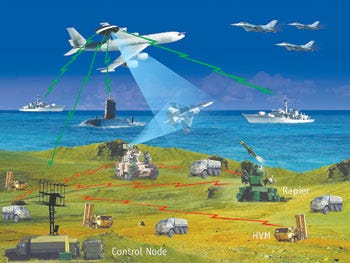
In 1996, NATO Admiral William Owens introduced the concept of a ‘system of systems‘ in a paper published by the Institute for National Security Studies in the United States. He described a system of intelligence sensors, command and control systems, and precision weapons that provided situational awareness, rapid target assessment, and distributed weapon assignment.
Also in 1996, the United States’ Joint Chiefs of Staff released Joint Vision 2010, which introduced the military concept of full-spectrum dominance. Full Spectrum Dominance described the ability of the US military to dominate the battlespace from peace operations through to the outright application of military power that stemmed from the advantages of information superiority.
Understanding Information Age Warfare:
Network-centric warfare was followed in 2001 by Understanding Information Age Warfare (UIAW), jointly authored by Alberts, Garstka, Richard Hayes of Evidence Based Research and David A. Signori of RAND. UIAW pushed the implications of the shifts identified by network-centric warfare in order to derive an operational theory of warfare.
Starting with a series of premises on how the environment is sensed, UIAW describes three domains. The first is a physical domain, where events take place and are perceived by sensors and people. Data emerging from the physical domain is transmitted through an information domain. It is processed in a cognitive domain before being acted upon.
The process is similar to a “observe, orient, decide, act” loop described by Col. John Boyd of the USAF.
Network Centric Warfare:
The term “network-centric warfare” and associated concepts first appeared in the United States Department of Navy’s publication, “Copernicus: C4ISR for the 21st Century.” The ideas of networking sensors, commanders, and shooters to flatten the hierarchy, reduce the operational pause, enhance precision, and increase speed of command were captured in this document. As a distinct concept, however, network-centric warfare first appeared publicly in a 1998 US Naval Institute Proceedings article by Vice Admiral Arthur K. Cebrowski and John Garstka. However, the first complete articulation of the idea was contained in the book Network Centric Warfare: Developing and Leveraging Information Superiority by David S. Alberts, John Garstka and Frederick Stein, published by the Command-and-Control Research Program (CCRP). This book derived a new theory of warfare from a series of case studies on how business was using information and communication technologies to improve situation analysis, accurately control inventory and production, as well as monitor customer relations.

The House of Peace where war is planned & waged 24-7, Geneva Global Governance.